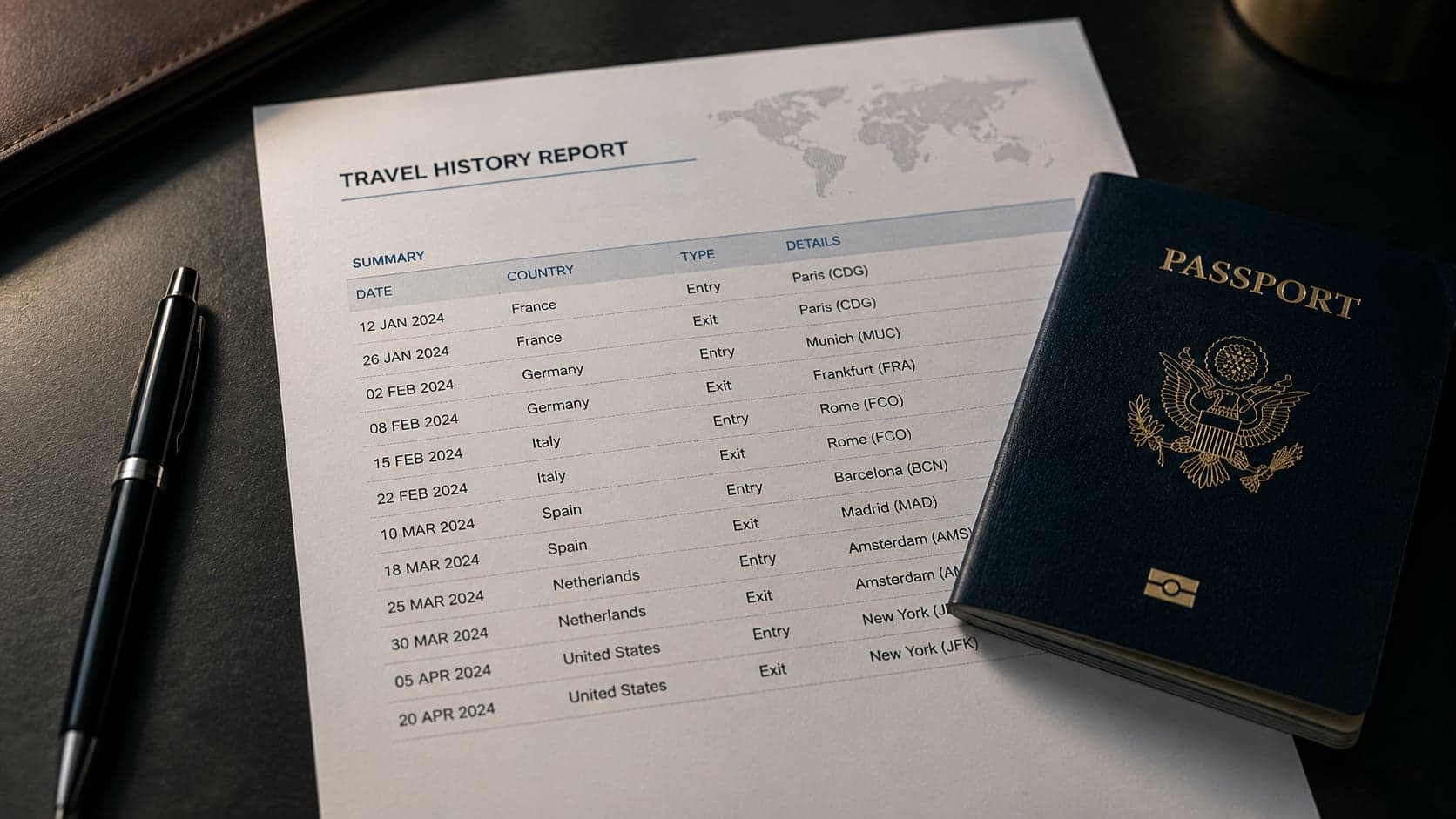
Arjun had been planning his UK visa application for three months.
He had the bank statements. He had the employer letter. He had the property documents. What he did not have — what he had never thought to keep — was a clean record of where he had been for the last ten years.
The UK visa application asks for it. So does the Schengen application. So does Canada. So does the US B1/B2. Every major visa-issuing country wants to know where you have been, when you entered, when you left, and why.
Arjun is a software engineer based in Bangalore. He travels three or four times a year — client visits to Singapore and Dubai, a holiday to Thailand, a conference in Amsterdam. Not unusual for someone in his position. But ten years of those trips, with exact entry and exit dates, across four different passports?
He spent two weekends trying to reconstruct it.
What visa officers actually want to see
A travel history report for a visa application is not a casual list. Immigration officers want:
- Country visited
- Entry date
- Exit date
- Purpose of visit
- Duration of stay
For a UK visa, they want five years. For a US visa, they sometimes ask for ten. For Schengen, the last ten years of visits matter for the Schengen 90/180 calculation. For Canada, there is no government portal where you can retrieve your own entry records — you are entirely dependent on what you have kept yourself.
Most people have not kept anything. They have passport stamps on expired passports, boarding pass photos buried in their camera roll, and a vague memory of which year they went to Dubai.
That is not enough.
The reconstruction problem
When Arjun sat down to build his travel history, he had four sources:
His current passport — two years old, a handful of stamps, mostly eVisas with no physical record. His previous passport — expired in 2022, stamps from Singapore, Thailand, the UAE, one Schengen entry. A passport before that — somewhere in a drawer at his parents' house in Chennai. And email — booking confirmations, hotel receipts, airline itineraries going back years if he searched hard enough.
Reconstructing from these four sources took him most of a Saturday. He built a spreadsheet. He cross-referenced email dates against passport stamps. He called his travel agent for old booking records. He still was not sure he had it right.
This is the standard experience for anyone who has been travelling for more than a few years and never kept a running record.
What PassportTrail generates
A travel history tracker like PassportTrail keeps a running log of every trip you add — country, entry date, exit date, purpose, which passport you were travelling on. When a visa application asks for your travel history, you open PassportTrail and export.
The export is a formatted PDF. It includes:
- Your name and passport details
- Every trip in chronological order
- Entry and exit dates
- Country and purpose
- Duration of each stay
- Total countries visited
- Schengen day calculations if relevant
It is formatted the way immigration officers expect to see it. Not a raw spreadsheet export. Not a personal document with your own formatting. A clean, professional travel history report.
For Arjun, once his history was logged, the export took thirty seconds.
The one-time setup problem
The honest answer is that building your history from scratch takes time. If you have been travelling for ten years and never kept records, setting up from scratch takes a few hours of reconstruction work — emails, old passports, booking confirmations, bank statements.
That is a one-time cost. Every trip you log going forward takes thirty seconds. Entry date, exit date, country, done. The next time a visa application asks for your travel history, you open PassportTrail and export.
Arjun now logs every trip the day he lands. Thirty seconds at the airport. His next UK visa application, whenever it comes, will take minutes instead of weekends.
Who needs this most
If you travel more than twice a year and apply for visas regularly — UK, Schengen, US, Canada, Australia — you need a running travel record. Not because immigration is difficult. Because the moment they ask and you do not have it, the cost of reconstruction is enormous.
South Asian passport holders — Indian, Bangladeshi, Sri Lankan, Nepali — typically need visas for most destinations. That means regular applications, regular requests for travel history, and regular scrambles to produce documentation that should have been kept all along.
PassportTrail is the running record. Start logging now, before the next application asks.