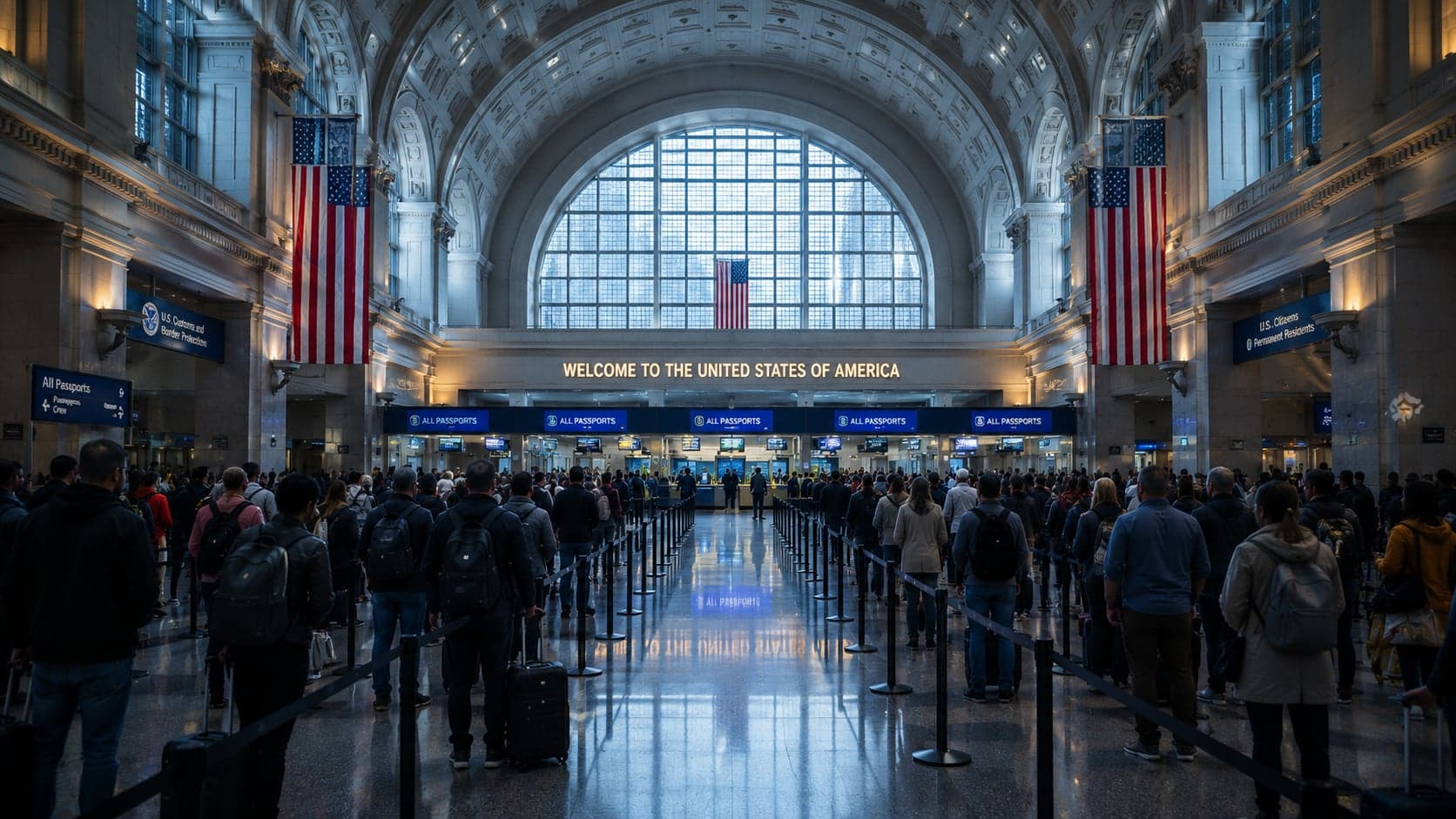
Every time you enter the United States, Customs and Border Protection creates a record.
Your name, your passport number, your port of entry, your admission class, your authorised period of stay. It goes into a database. It stays there.
The good news is that you can access it. The bad news is that most people do not know the portal exists — and when a visa application asks for US travel history, they are left trying to reconstruct entries from passport stamps that may or may not exist.
The i94 portal
The portal is at i94.cbp.dhs.gov.
You do not need to create an account. You enter your name, date of birth, passport number, and country of citizenship. The system returns your most recent I-94 record and a full travel history of every US entry on record.
It takes about two minutes.
For Rajan, a software architect from Hyderabad who visits US clients three or four times a year on a B1/B2 visa, the portal showed eleven entries going back to 2017. Dates, ports of entry, admission classes, authorised stay periods — all of it in one place.
He had been manually tracking his US entries in a notes app. He deleted the notes app.
What the portal shows and what it does not
The i94 portal shows every recorded US entry. It does not show exits.
The United States does not stamp exits. There is no exit record in the i94 system. When you leave the US, nothing is recorded on the CBP side — your departure is inferred from your next entry or from airline data that CBP receives separately.
This matters for visa applications that ask for both entry and exit dates. For US visits, your exit date is typically:
- Your next i94 entry date minus one day
- Your flight booking confirmation date
- Your hotel checkout date
- Your next stamp in another country
Cross-reference these sources. Most people can reconstruct exit dates accurately with a little effort.
What Canada does instead
Canada has no equivalent portal.
The Canada Border Services Agency keeps entry records — but they are not accessible to the public. There is no online portal where you can retrieve your Canadian entry history. If a visa application asks for your Canadian travel history, you are entirely dependent on your own records, passport stamps, and whatever documentation you have kept.
This is one of the strongest arguments for keeping your own running travel record from day one. Government portals like i94 are useful where they exist. Where they do not — Canada, most of Asia, most of Africa — your personal record is all you have.
Logging your US history in PassportTrail
Once you have pulled your i94 history, setting up your full PassportTrail record takes about fifteen minutes per decade of trips.
For each US visit: - Country: United States - Entry date: from i94 - Exit date: reconstructed from the sources above - Purpose: Business / Tourism / Conference / Family visit
PassportTrail stores the complete record. When your next visa application — UK, Schengen, Canada, Australia — asks for a travel history report, you open PassportTrail and the data is already there. No portal visit required, no reconstruction, no guesswork.
One more thing about the i94
Check your i94 record before your next US entry, not after.
Occasionally, CBP records contain errors — a wrong admission class, an incorrect authorised stay period, a name discrepancy. If you have an error on your i94 record, the time to discover it is before you apply for your next visa — not at the port of entry.
The portal has a correction request process. It takes time. Start it early.
For Rajan, the portal showed everything correctly. He added all eleven entries to PassportTrail in about fifteen minutes. His next UK visa application, which asked for all US visits in the last ten years, took four minutes to complete.
That is the value of knowing where your records are.