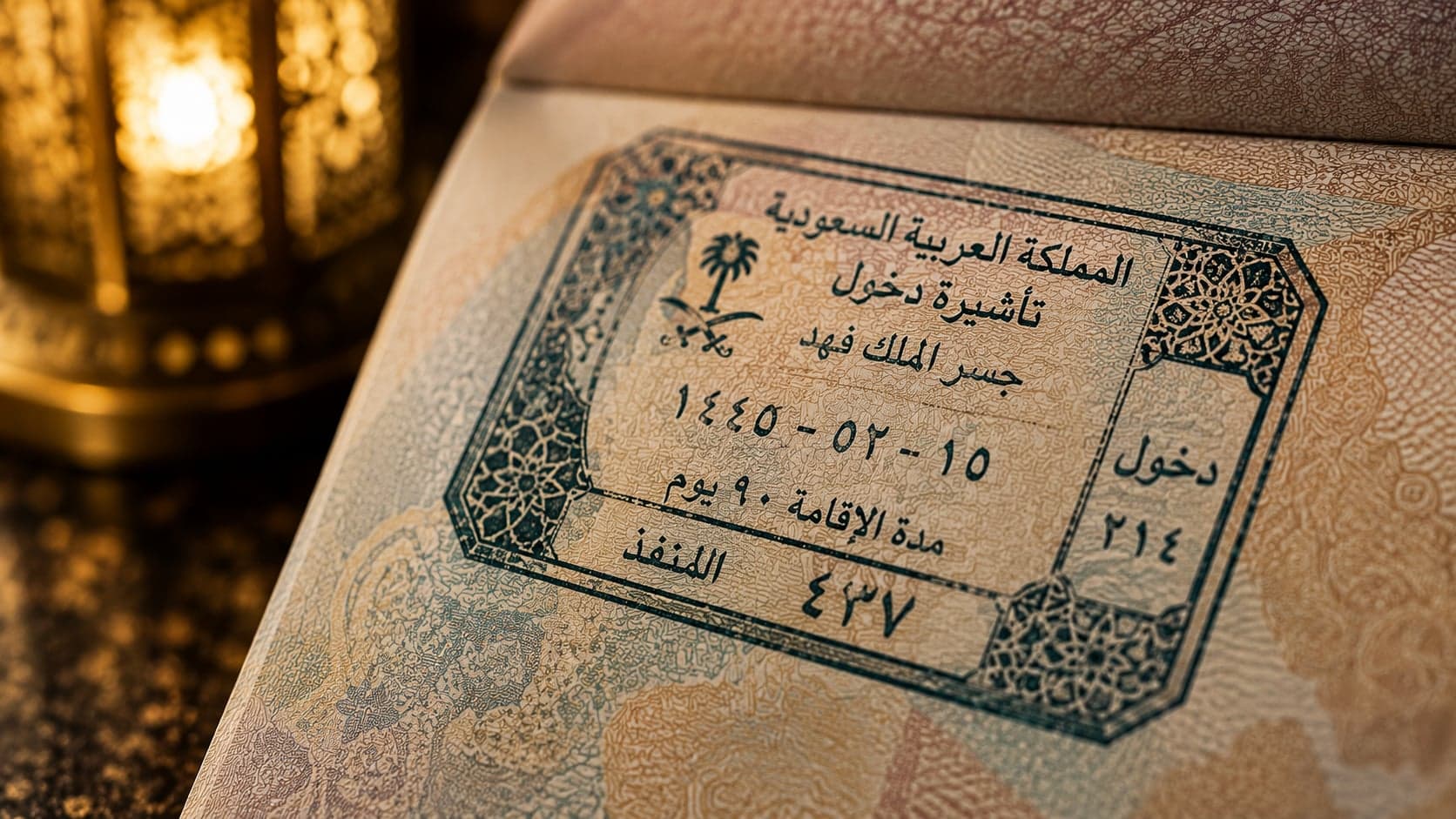
If you've visited Saudi Arabia for Umrah, Hajj, business, or tourism, you have Arabic stamps in your passport. Possibly many of them, spread across random pages, stamped wherever the officer happened to open. And if you've ever sat down to reconstruct your Saudi travel history for a travel history report or visa application, you'll know the problem.
The dates are in Hijri. The month names are in Arabic. And a stamp from what appears to be "1443" means nothing to a UK visa officer who wants a year between 2000 and 2024.
Here's how to decode them.
Understanding the Hijri calendar
The Islamic calendar is a lunar calendar with 12 months and approximately 354 days per year — about 11 days shorter than the Gregorian calendar. This means Hijri years advance faster than Gregorian years, and the same Gregorian month falls in a different Hijri month every year.
The current Hijri year as of 2026 is 1447-1448 AH. A stamp showing 1443 is from approximately 2021-2022 in Gregorian terms.
To convert a Hijri date to Gregorian, the simplest approach is to use a reliable online converter. islamicfinder.org and hijritogregorian.com are both accurate and straightforward. Enter the Hijri day, month, and year and get the Gregorian equivalent immediately.
Saudi government apps including the Absher platform also show your visit history with both Hijri and Gregorian dates if you have access to it.
The 12 Islamic months — Arabic and English
This is what you'll see stamped in your passport. The month name appears in Arabic script, usually abbreviated:
1. مُحَرَّم — Muharram 2. صَفَر — Safar 3. رَبِيع الأوَّل — Rabi al-Awwal 4. رَبِيع الثَّانِي — Rabi al-Thani 5. جُمَادَى الأُولَى — Jumada al-Awwal 6. جُمَادَى الثَّانِيَة — Jumada al-Thani 7. رَجَب — Rajab 8. شَعْبَان — Sha'ban 9. رَمَضَان — Ramadan 10. شَوَّال — Shawwal 11. ذُو الْقَعْدَة — Dhul Qa'dah 12. ذُو الْحِجَّة — Dhul Hijjah
Dhul Hijjah is the month of Hajj — if your stamp shows month 12, that visit was almost certainly for Hajj or immediately around it. Ramadan visits are usually for Umrah. Knowing this helps you cross-reference with your memory.
How stamps appear in Saudi passports
Saudi stamps are not always consistent. Entry and exit stamps may appear on different pages — officers stamp wherever the passport opens, not necessarily in sequence. A single visit can have its entry stamp on page 8 and exit stamp on page 22.
The stamp typically shows:
- Entry or exit (دخول = entry, خروج = exit)
- Port of entry (جدة = Jeddah, الرياض = Riyadh, المدينة = Madinah)
- Date in Hijri (day/month/year)
- Sometimes a Gregorian date alongside it — but not always
Cross-referencing with other sources
Because Saudi stamps alone can be ambiguous, always cross-reference with at least one other source:
Boarding passes are the most reliable. If you kept them, the date printed is always Gregorian. Even a photo of the boarding pass on your phone from years ago is enough to confirm the exact date.
Airline booking confirmations in your email — search for the airline name or "Jeddah" or "Riyadh" in your inbox. Booking confirmations show departure and return dates in Gregorian.
Home country entry stamps — if your home country stamps on entry, the stamp you received when you returned from Saudi Arabia is in Gregorian and gives you your exit date from Saudi (or close to it, accounting for travel time).
Bank statements — a SAR cash withdrawal or card transaction in Saudi Arabia confirms you were there on that date.
Recording Saudi visits in PassportTrail
When logging your trips in PassportTrail, always use Gregorian dates — that's what compliance calculations and visa reports use. Convert your Hijri stamp date using one of the converters above, cross-reference with your boarding pass or email, and log the confirmed Gregorian date.
For Umrah and Hajj visits, note the purpose — it's useful context when a visa application asks about the nature of your travel, and it helps you remember which visit was which when you have multiple Saudi stamps across several passports.