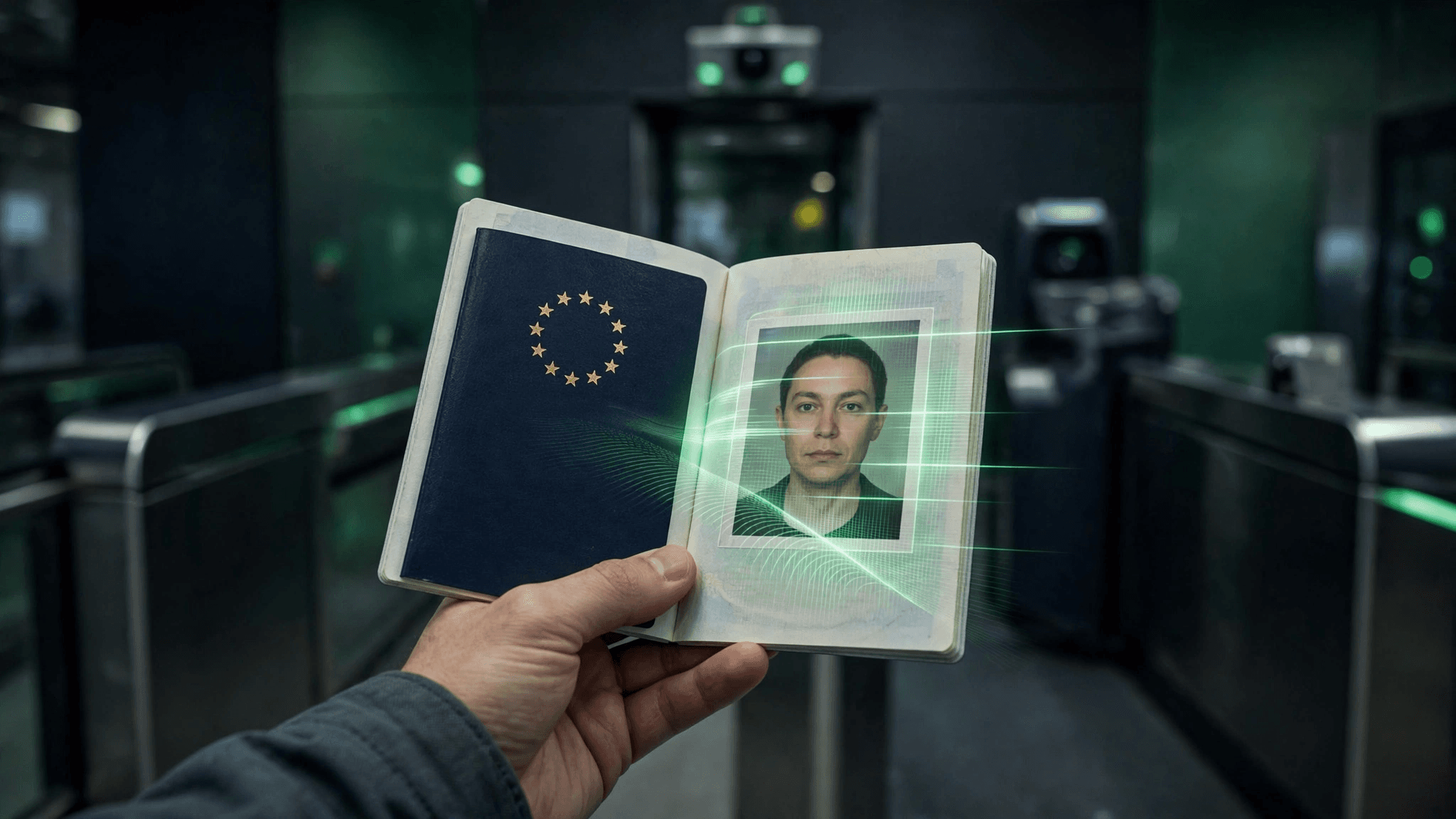
When Lena landed at Lisbon airport this spring, something felt off. The border officer scanned her passport, took her photo, asked her to press her fingers on a glass panel — and handed the passport back without a stamp. No ink, no date, no proof she'd ever arrived. "How do I prove when I entered," she wondered on the way to baggage claim, "if there's nothing in my passport?"
If you've travelled to the Schengen area recently, you've probably had the same moment. Europe's Entry/Exit System — EES — is now fully operational, and the passport stamp, that little ritual of international travel, is quietly disappearing.
What the EES actually is
The EES is the European Union's digital border system for non-EU nationals travelling for short stays. After a phased rollout that began in October 2025, it became fully operational at all external Schengen border crossing points on 10 April 2026, according to the European Commission. By late July 2026 it had already registered more than 145 million entries and exits.
Instead of stamping your passport, the system records your travel document details, a facial image, fingerprints, and the date and place of your entry and exit. The data is stored centrally and used, among other things, to identify overstayers.
What hasn't changed
This is the part people get wrong: the EES has not changed the underlying stay rule. The familiar limit of 90 days in any rolling 180-day period still applies to short stays. The system simply makes your entries and exits verifiable — for the authorities, not for you.
That's the catch. The EES is a border-management tool. It doesn't give you a personal dashboard, a day counter, or a neat list of your trips. You can't log in and check how many Schengen days you have left.
Who it affects — and who it doesn't
The EES applies to non-EU nationals travelling for a short stay. EU citizens and nationals of Iceland, Liechtenstein, Norway and Switzerland are not registered. Neither are travellers holding long-stay visas or residence permits issued by a participating country.
If you're a frequent traveller from, say, Pakistan, India, the UK or the US visiting Europe for business or holidays, the EES now records every one of your Schengen entries and exits — whether or not you ever see a stamp again.
Why your own records matter more than ever
Here's the practical problem Lena ran into. A few months after her Lisbon trip, she was filling in a visa application that asked for her travel history over the past five years, with exact dates. Her old method — flipping through passport pages and reading stamps — doesn't work anymore. The stamps stopped. The EES has the data, but she can't access her own EES record the way she could read a stamp.
This is the new reality of travel documentation: the authorities keep better records than ever, while travellers keep worse ones. If a question ever arises about your movements — a visa interview, a stay-limit query, an application form — the burden of proof is still on you.
The fix is unglamorous but effective: keep your own independent log. Every trip, every entry date, every exit date, recorded at the time. Don't rely on stamps that no longer exist, booking emails scattered across inboxes, or memory.
How PassportTrail fits in
This is exactly the gap PassportTrail was built for. Log each trip as you take it — entry and exit dates, country, purpose — and the app maintains your running history automatically. For Schengen travel, it tracks your 90/180-day position from your own logged trips, so you're never guessing how many days you have left. And when a visa application asks for five years of travel history, you generate a clean report in minutes instead of spending a weekend reconstructing it from fragments.
The border now remembers everything. Make sure you do too.
Note: border procedures evolve. Always verify current entry requirements with official sources such as the European Commission's migration and home affairs pages before you travel. PassportTrail provides personal record-keeping tools, not legal or immigration advice.